The LPHC Protocol: Engineering the 100-Year Sprinter body CENTENARIAN OS v2.1 | PUBLISHED: 2026-02-16 | CATEGORY: PERFORMANCE
The LPHC Protocol: Engineering the 100-Year Sprinter
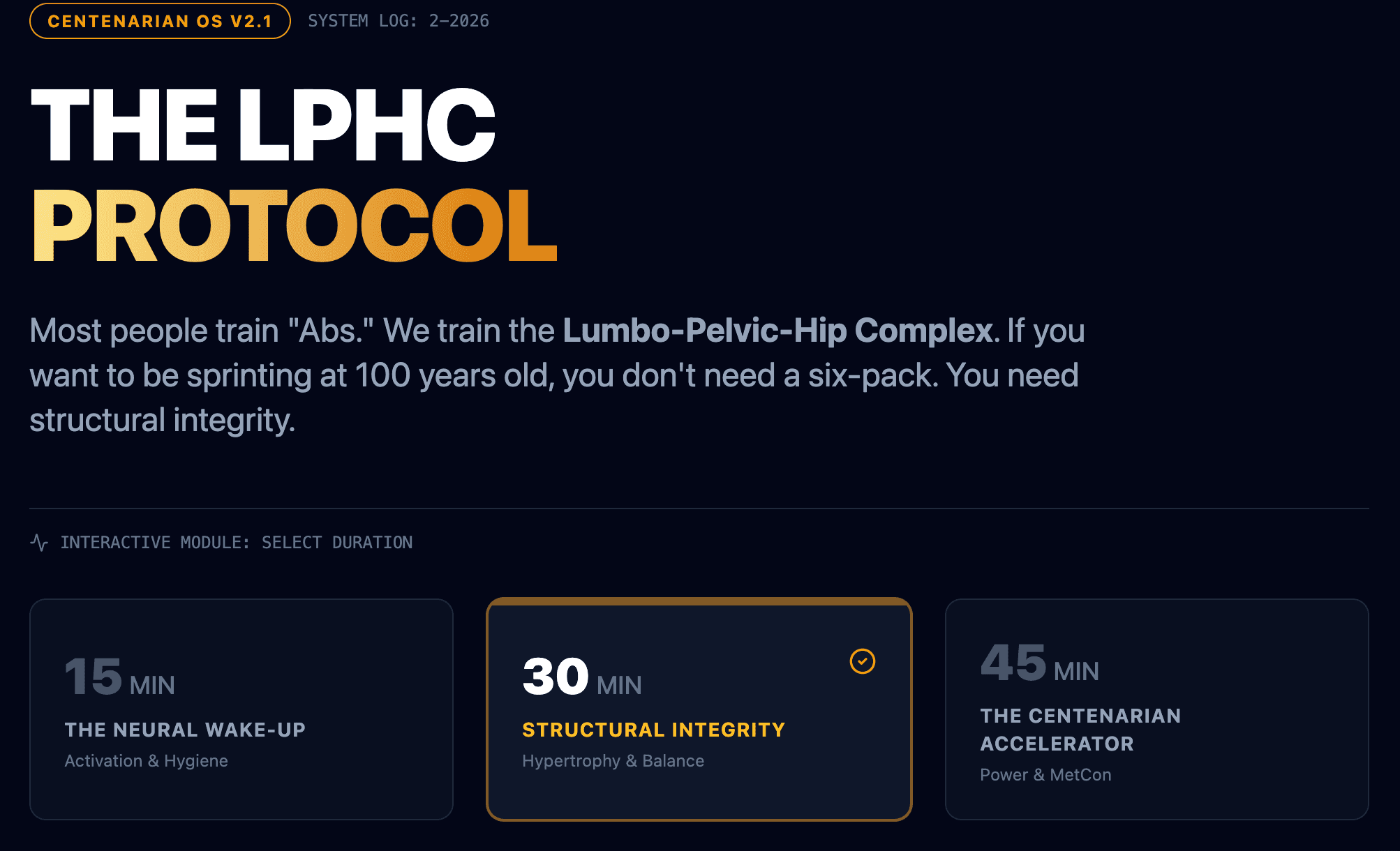
Most people train "Abs." We train the Lumbo-Pelvic-Hip Complex. If you want to be sprinting at 100 years old, you don't need a six-pack. You need structural integrity.
Tools do not create results; strategy does. This is a modular system designed to target the LPHC—the engine of the 100-year sprinter. Below are the three strategic tiers of the Centenarian Protocol.
PROTOCOL 1: The Neural Wake-Up (15 Minutes)
Focus: Activation & Hygiene
Intensity: Low (3/10) | Stability: High (9/10)
Tools Required: Vibrating Roller, Mini Bands, Stability Ball, Balance Disc, KB
Daily maintenance to reverse the effects of sitting. Targets the 'sleeping' muscles (glutes, deep core) to prevent regression.
0-3 MIN Inhibition: Calves & TFL Recovery
Execution: Turn on vibration. Roll slowly (1 inch per second) along the calf muscle belly and the TFL (pocket muscle).
Coaching Cue: "When you find a 'hot spot' (trigger point), hold static pressure for 30-45 seconds until it releases. The vibration helps override pain receptors."
The Why: Releases tension in the muscles that get tight from sitting and walking, restoring length-tension relationships.
3-6 MIN Activation: Monster Walks Stability
Execution: Place band around ankles. Stand with feet hip-width apart, knees slightly bent. Step laterally (sideways) keeping toes pointed straight ahead.
Coaching Cue: "Do not let knees cave inward (valgus). Keep tension on the band the entire time. 15 steps left, 15 steps right."
The Why: Fires the Gluteus Medius, essential for stabilizing the pelvis during single-leg stance (sprinting).
6-9 MIN Global Core: Ball Pikes Core
Execution: Start in a push-up position with shins on the ball. Keeping legs straight, pike your hips up toward the ceiling, rolling the ball toward your hands.
Coaching Cue: "Exhale as you pike up. Inhale as you return to flat plank. Do not let the lower back sag."
The Why: Integrates shoulder stability with deep abdominal flexion.
9-12 MIN Local Core: Instability Plank Core
Execution: Place forearms on the inflated balance disc. Extend legs back into a plank position. Hold.
Coaching Cue: "The disc will wobble. Fight to keep it still. Squeeze glutes and draw belly button to spine. 2 sets x 45 seconds."
The Why: Forces the Transverse Abdominis to fire rapidly to stabilize the spine against unpredictable movement.
12-15 MIN Integration: KB Swing (Hinge) Power
Execution: Hinge at the hips (butt back), keeping shins vertical. Snap hips forward explosively to float the bell to chest height.
Coaching Cue: "This is a HIP SNAP, not a squat. Your arms are just hooks; the power comes from the glutes."
The Why: Teaches the posterior chain to fire explosively—the engine of your sprint.
PROTOCOL 2: Structural Integrity (30 Minutes)
Focus: Hypertrophy & Balance
Intensity: Moderate (6/10) | Stability: High (8/10)
Tools Required: Power Tower, Stamina X Box, Rehab Bands, Previous Tools
The bread and butter. Builds the hamstring/glute connection and forces the LPHC to stabilize under load.
0-15 MIN Warm-Up Sequence Warmup
Execution: Complete the 15-minute activation routine above (SMR, Monster Walks, Ball Pikes).
The Why: Do not skip this. You cannot build structure on a shaky foundation. Prepares the nervous system for load.
15-18 MIN Balance: Single-Leg RDL Stability
Execution: Stand on one leg. Hold KB in the OPPOSITE hand. Hinge at hips, extending free leg straight back. Return to standing.
Coaching Cue: "Keep hips square to the floor (don't rotate open). 4-2-1 Tempo (4s down, 2s hold, 1s up)."
The Why: Builds hamstring strength and rotary stability simultaneously.
18-21 MIN Core: Hanging Knee Raises Core
Execution: Hang from bar or use elbow pads. Draw knees up toward chest. Curl the pelvis at the top.
Coaching Cue: "Do not swing. Control the descent. To progress: Straight Leg Raises (Toes to Bar)."
The Why: Decompresses the spine while training the hip flexors and lower abs.
21-24 MIN Push: Unstable Push-Up Strength
Execution: Place hands on the sides of the stability ball. Perform push-ups while balancing.
Coaching Cue: "Keep elbows tucked 45-degrees. If too hard, perform with knees on ground."
The Why: Increases recruitment of the shoulder stabilizers and core compared to floor push-ups.
24-27 MIN Pull: Inverted Row or Pull-up Strength
Execution: Pull-up: Palms away, chin over bar. Inverted Row: Hang under bar, heels on ground/box, pull chest to bar.
Coaching Cue: "Use Rehab Bands for assistance if you cannot do 8 clean reps. Focus on depressing shoulder blades first."
The Why: Counteracts the 'rounded shoulder' posture of modern life.
27-30 MIN Legs: Step-Up to Balance Power
Execution: Step onto box. Drive through the heel to stand up, bringing the OPPOSITE knee high into the air. Balance on one leg for 2s.
Coaching Cue: "Do not push off the back leg. Make the top leg do the work. Land softly."
The Why: Mimics the drive phase of sprinting mechanics.
PROTOCOL 3: The Centenarian Accelerator (45 Minutes)
Focus: Power & MetCon
Intensity: High (9/10) | Power Output: Max (10/10)
Tools Required: Jump Rope, Power Bands, Bike, Stamina X Box
Maximum caloric burn and Type II fiber recruitment. Develops the explosive 'drive phase' for the 100m sprint.
0-15 MIN Warm-Up Sequence Warmup
Complete the 15-minute activation routine. Essential for plyometric safety.
15-27 MIN Structural Strength Block Strength
Execution: Perform Single-Leg RDLs, Hanging Knee Raises, Unstable Push-Ups, and Pull-Ups from the 30-min routine.
Note: Perform 2 sets of each instead of 3 to save energy for Power block.
⚠️ PROTOCOL OVERRIDE: We SKIP the "Step-Up to Balance" in this tier. Skipping this preserves explosive energy for the box jumps immediately following.
27-32 MIN Plyo: Box Jumps Power
Execution: Stand in front of box. Squat slightly and explode up, landing softly on the box in a squat position. Stand tall.
Coaching Cue: "STEP DOWN ONE FOOT AT A TIME. Do not jump down (saves Achilles). Focus on quiet landings."
The Why: Targeting Type II (Fast Twitch) fibers. "Anti-aging" for the nervous system.
32-36 MIN Speed: Jump Rope Intervals Cardio
Execution: 60 seconds on, 30 seconds off. Focus on minimal ground contact time.
Coaching Cue: "Stay on balls of feet. Flick wrists, don't swing arms."
The Why: Increases lower leg stiffness (springiness) for efficient energy return.
36-40 MIN Power: Woodchops Core
Execution: Anchor band high. Pull diagonally down across body, pivoting the back foot. Return slowly.
Coaching Cue: "Explosive pull (1s), controlled return (3s). 15 reps per side."
The Why: Sprinting is a rotational act; this prevents energy leaks through the torso.
40-45 MIN Finisher: Bike Sprints MetCon
Execution: Tabata Style: 20 seconds Max Effort Sprint, 10 seconds complete rest. Repeat for 4 minutes.
Coaching Cue: "If you aren't breathless, increase resistance."
The Why: Flushes lactate and improves Heart Rate Variability (recovery capacity).
The "Core" is a Myth
In the Centenarian Journey, we don't use vague terms. "Core" is marketing. LPHC (Lumbo-Pelvic-Hip Complex) is anatomy.
The LPHC is the powerhouse of the human body. It has 29 muscles attached to the lumbo-pelvic-hip complex. If these muscles are weak or unstable, the extremities (arms and legs) cannot produce force efficiently. Think of it like shooting a cannon from a canoe. The cannon (legs) might be powerful, but if the canoe (LPHC) is unstable, the energy is lost to the water.
The Centenarian Constraint: To sprint at age 100, you cannot have "energy leaks." Every ounce of force your foot generates into the ground must be transferred through a rigid torso to propel you forward.
The Strategy: Local vs. Global
This protocol uses the NASM OPT™ Model to distinguish between two critical systems:
1. Local Stabilization System: The "Inner Unit" (Transverse Abdominis, Multifidus). These muscles attach directly to vertebrae. They don't move you; they stabilize the spine before you move. We train these with the Balance Disc and Stability Ball.
2. Global Movement System: The "Outer Unit" (Rectus Abdominis, Obliques, Glutes). These move the trunk and transfer load. We train these with the Stamina X Box and Power Tower.
Why These Durations?
15 Minutes (Hygiene): You brush your teeth daily to prevent decay. You must do the "Neural Wake-Up" daily to prevent Gluteal Amnesia caused by sitting. This is not a workout; it is hygiene.
45 Minutes (Performance): This targets Type II (Fast Twitch) muscle fibers using plyometrics. These fibers are the first to atrophy with age. Using the Stamina X Box for jumps is literally "Anti-Aging" for your nervous system.